

A new framework for designing “chronocities”: cities that align urban life with human biological rhythms, translating chronobiology into policies on lighting, work, education, and health to improve wellbeing, sustainability, and productivity.
More than 200 participants from around the world gathered to discuss how time policies can tackle urgent challenges such as sleep deprivation, time poverty, and the environmental impacts of a 24/7 society.
The Agenda turns advances in chronobiology — recognised by the 2017 Nobel Prize in Physiology or Medicine — into concrete public policies that help cities synchronise daily life with human and natural rhythms.
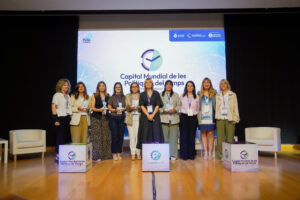
On 17 June, the Local and Regional Time Network presented the Local and Regional Time Agenda 6, a new edition that introduces the concept of chronocities — cities designed to function in harmony with human biological clocks — and compiles innovative practices to guide their implementation across cities and regions. As societies continue to operate in a 24/7 context, the misalignment between social schedules and biological rhythms has become an increasingly urgent challenge, affecting health, productivity, equality and environmental sustainability.
The presentation event included a keynote address by Professor Diego Golombek, who defined chronocities as urban environments that recognise that we are all governed by internal clocks and that cities must measure and understand how they function in time to design better policies. He highlighted key areas such as light exposure, school and work schedules, healthcare organisation and shift work as central to building chronosensitive cities.
The session also featured a roundtable discussion with international experts. Camilla Kring, PhD, addressed how chronoleadership can help redesign working time by adapting schedules to people’s chronotypes, which define human rhythms according to adaptation to different hours of the day and night. Professor Scott Bremer introduced the idea of multiple time worlds coexisting within cities and stressed the need for new governance approaches to coordinate them. Professor María Fernanda Zerón-Rugerio focused on education and health, highlighting the importance of aligning school schedules with biological rhythms and addressing widespread sleep deprivation.
The practical dimension was illustrated by Michael Wieden through the pioneering experience of Bad Kissingen, the world’s first chronocity pilot, showing how chronobiology can be applied in real urban contexts. Insights from the event discussions also reinforced that chronocities are not a one-off project, but a gradual transformation: cities must start with specific sectors, build awareness, collect data and progressively embed rhythms — not just clock time — into decision-making.
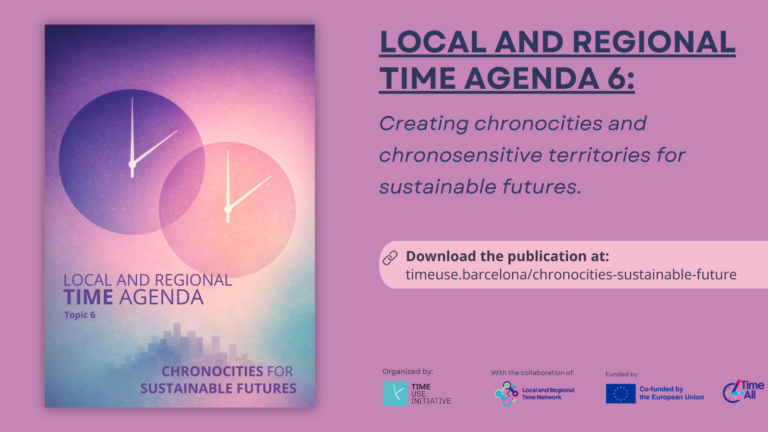
Local and Regional Time Agenda 6 ‘Chronocities for Sustainable Futures’
Time Agenda 6 focuses on bridging the gap between scientific knowledge and public policy. Chronobiology — the study of biological rhythms — has gained international recognition, notably with the 2017 Nobel Prize in Physiology or Medicine awarded for discoveries on the molecular mechanisms controlling circadian rhythms.
The publication translates these scientific insights into practical recommendations, showing how local and regional governments can redesign urban systems to align with human and natural rhythms. It highlights that current time structures often favour early schedules that benefit only a minority, contributing to widespread “social jet lag”, sleep deprivation and reduced wellbeing.
To operationalise this approach, the Agenda defines two main pillars for building chronosensitive territories:
- Pillar 1: Regulation, urban planning and public policies aligned with human and natural rhythms. This includes measures such as adapting urban lighting to reduce light pollution, rescheduling public services to avoid night-time disturbance, aligning school and work schedules with biological needs, and developing circadian-friendly healthcare systems.
- Pillar 2: Awareness, social habits and data collection. Given the novelty of chronobiology in public discourse, cities must raise awareness and collect data on time use — including sleep, mobility and digital habits — to support informed decision-making and encourage behavioural change.
The Agenda also includes concrete examples, such as the chronocity pilot in Bad Kissingen, demonstrating how integrating chronobiology into education, healthcare and working life can improve wellbeing, productivity and urban sustainability; the case of Viladecans, which shows the importance of local demands towards supra-local entities — such as maintaining winter time — can support climate adaptation, reduce energy consumption and improve sleep; and the analysis carried out in Barcelona, which translates scientific evidence into public policy recommendations by analysing how urban schedules, lighting and lifestyles affect biological rhythms and by promoting a “circadian city” approach to improve health and quality of life.
Together, these cases show that chronocities are not a single intervention but a systemic transformation that combines regulation, awareness and data to align cities with the rhythms of life. The Agenda also highlights key areas for action, including circadian-friendly public services, chronoleadership in work organisation, and data-driven approaches to understanding how cities function in time.
To know more
The Local and Regional Time Agenda is the leading international publication that compiles good practices in time policies implemented by cities and regions around the world to improve people’s lives. It is coordinated by the Local and Regional Time Network, an international alliance of governments that promotes the right to time around the world.
Each edition offers ideas, best practices and recommendations to help territories implement time policies. To date, the Time Agenda has benefited more than 90 million people in Europe, Asia and the Americas.
Previous editions have addressed topics such as work-life balance, sustainable mobility, democratic participation, night-time policies, and working time: