

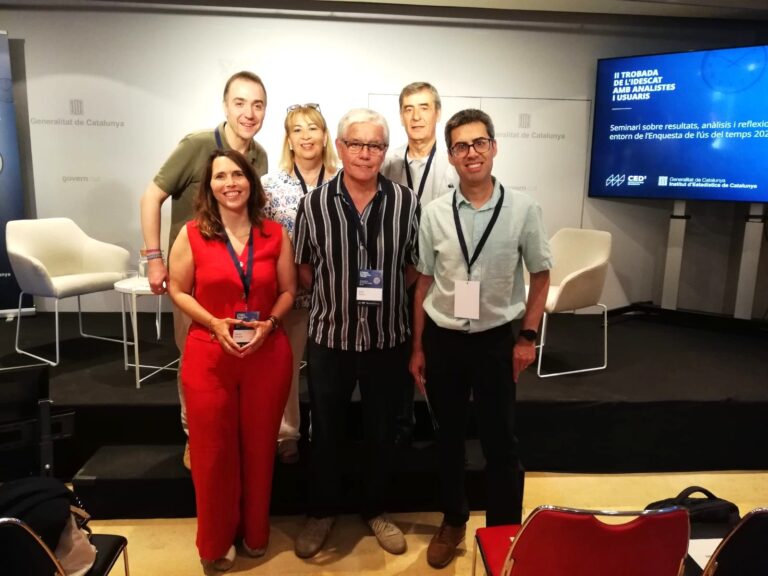
The Time Use Initiative (TUI) participated in the II Meeting with Analysts and Users organised by the Institut d’Estadística de Catalunya (Idescat) and the Centre d’Estudis Demogràfics (CED), held on 1 and 2 June 2026 at the Cotxeres Hall of Barcelona’s Palau Robert. The event brought together analysts, researchers, and advanced users to discuss the first results of the 2024 Catalan Time Use Survey, with TUI contributing to the analysis and dissemination of key findings.
This new edition positions Catalonia as a leading territory in time-use statistics. It is the first region to publish harmonised data within the third wave of the European HETUS framework, ahead of other national releases. This reinforces the strategic role of Catalonia in advancing internationally comparable and policy-relevant data. The survey provides a comprehensive picture of how people distribute their time across paid work, unpaid work, care, leisure, rest, and digital activities.
A key innovation of the 2024 survey is the incorporation of new analytical dimensions, particularly the measurement of mental load associated with household and family responsibilities, as well as the inclusion of teleworking. These additions expand the scope of analysis and make visible forms of work that have traditionally remained hidden. While gender gaps in paid and unpaid work continue to narrow, the results highlight that mental load remains highly unequal, pointing to persistent structural inequalities that require targeted policy responses.
Another major contribution is the unprecedented level of territorial disaggregation. The survey provides data for Barcelona city, the metropolitan area (with and without Barcelona), the broader metropolitan territory, and the rest of Catalonia, enabling a much more granular understanding of daily life. This level of detail opens new opportunities for place-based policies, ensuring that interventions can better reflect different territorial realities.
Beyond methodological innovations, the findings reflect broader transformations in everyday life. Overall, time devoted to both paid and unpaid work has decreased, while leisure time has increased. However, one of the most significant changes is the sharp rise in time spent connected to digital devices, pointing to structural shifts in social interaction, productivity, and well-being. These trends underline the growing importance of integrating time-use data into policy debates on digitalisation and quality of life.
TUI contributed to the seminar through the participation of Marta Junqué, José Ángel Rodríguez Fernández, and other members of the time-use research community, highlighting the importance of harmonised, accessible, and policy-oriented data. The discussions also stressed the need to improve the communication and practical use of time-use statistics to ensure they effectively inform public debate and decision-making.
Organised by Idescat and CED, the seminar reinforced the importance of collaboration between statistical institutions, academia, and policy actors. It also confirmed the strategic role of time-use data in addressing key societal challenges, from gender equality to time poverty, and in advancing towards a more equitable distribution of time as a fundamental social right.