

2025 has been a key year in achieving the right to time, with the issue increasingly becoming a central topic on the agendas of governments around the world. Throughout the year, all the agents collaborating with the Time Use Initiative (TUI) have achieved 12 milestones that reflect an international and local commitment to ensuring better time management in favour of equity, well-being, sustainability and efficiency, and which will form the basis of the work in 2026.
1. The right to time and time policies have been placed on the agenda of major international forums on urban and democratic innovation.

This year, the main forums for reflection and innovation on public policy have identified the right to time and time policies as a key issue that countries around the world must prioritize in order to address global challenges and ensure the well-being of their citizens.
In February, the event Local Government and Youth shaping the future, organized by United Cities and Local Governments (UCLG), incorporated the right to time into the conference “The new essentials: Priorities for Local and Regional Governments”, which led to the articles “Using the time factor to improve the well-being of cities and caring societies” and “Four infrastructures for transversally managing time and creating caring cities and regions”, published in GOLD VII magazine “Economies of Equality and Care”.
In March, the Istanbul Innovation Days (IDDs), the leading international event on institutional innovation organized by the United Nations Development Program (UNDP), addressed in its main discussion how time management is a key issue for institutional modernization. As a result of the conference, the article “Time Use Policies: Rethinking the Institutional Fabric Around Cross-Cutting Issues” was published and has reached governments around the world.
That same month, the event “New Rights for the 21st Century: Care and Time”, co-organized by the International Alliance for Care and TUI within the framework of CSW69/Beijing +30, asserted the right to care and time as pillars of a more equal and prosperous society.
In September, the 2025 Asia-Pacific Care Learning Week, which focuses on the exchange of good practices to promote fairer and more inclusive care systems in the Asia-Pacific region, placed time at the center of the “Caring Cities” workshop. In October, the Marmara Urban Forum, a meeting that seeks innovative urban solutions to address global challenges, hosted the roundtable “Tick-Tock, Tick-Tock, Local Time Policies”, where policies for a fairer and more efficient use of time in cities were presented. In November, the Dubai Future Forum delved deeper with the session “Concepts of Time: How They Shape Our Future”, reinforcing time as a strategic dimension for thinking about global horizons.
2. Catalonia remains the global epicentre of time policies

The main Catalan institutions promoting time policies—the Government of Catalonia, Barcelona City Council, Barcelona Provincial Council, and the Barcelona Metropolitan Area—together with the Time Use Initiative, have continued to work together to realize the right to time and promote the implementation of good practices in time policies at the national and international levels.
As a result of this collaboration, the inter-institutional working group has organized the 11th edition of Time Use Week 2025, the leading international event on time policies; it has consolidated the Local and Regional Time Network; and participated in the International Forum on Time in Bogotá, World Capital of Time Policies 2025, to exchange experiences and success stories with Latin American institutions.
As part of Time Use Week, Catalonia hosted an international visitor program—in collaboration with Catalonia International—to learn about successful Catalan projects in the field of time. Participants included Laura Tami, from the Bogotá Women’s Secretariat; Ana Tribín, senior economist at the World Bank; and Giulio Quaggiotto, former director of Strategic Innovation at the United Nations Development Programme (UNDP).
In parallel with their joint efforts, the institutions have also made independent progress in promoting a healthier, more equitable, efficient, and sustainable organization of time within their areas of competence.
The Government of Catalonia has organized the 3rd meeting of the Catalan Network for the Right to Time and has presented the Catalan Agenda for Work-Life Balance and Shared Responsibility, a new strategy to move towards a better social organization of time with a gender perspective.
The Barcelona City Council continues to promote the Time Agreement and the NUST Network and has published the 3rd edition of the report “Time policies promoted by the Barcelona City Council”, which includes 83 measures developed by different municipal areas.
The Barcelona Provincial Council has successfully rolled out the pilot plan to implement the Local Time Organization Plan (PLOT) in the municipalities of Sant Adrià de Besòs and El Prat de Llobregat, with the support of the Time Use Initiative.
The Barcelona Metropolitan Area (AMB), in collaboration with the Pi Sunyer Foundation and the Time Use Initiative, has published a comparative survey on time policies in metropolitan municipalities (2022-2024), which shows significant progress in their implementation. The AMB has also supported four municipalities in the development of new time policies: Santa Coloma de Gramenet, Hospitalet de Llobregat, Sant Boi de Llobregat, and Esplugues de Llobregat.
3. Pioneering collaboration agreement with UN Women Latin America and the Caribbean (LAC) to promote time policies in the region

For the first time in history, an agency within the United Nations ecosystem has signed a collaboration agreement with the TUI. Both organizations have committed to promoting awareness and training on time management and its impact on gender equality and social well-being, generating research and publications on time use in the region, and supporting governments and organizations in the design and adoption of time policies over the next three years.
This milestone is part of the celebration of the international forum on the Right to Time, “Women’s Time: Gender and City Building”, organized by Bogotá as the World Capital of Time Policies 2025, which has promoted knowledge and debate on the right to time and time policies in the region.
4. The local and regional time network for time policies continues to spread throughout the world

The Local and Regional Time Network, the international alliance of cities, metropolitan areas, and regions around the world committed to making the right to time a reality, has welcomed five new members: Union of Marmara Municipalities (Turkey), Municipality of Sosnowiec (Poland), Municipality of Braga (Portugal), and Prefecture of Guayas and Prefecture of Pichincha (Ecuador).
With these new additions, the Network now has more than 50 members from institutions in Europe, America, and Asia, representing over 90 million people. This is yet another sign of the interest generated by time policies.
5. Bogotá has been the World Capital of Time Policies for 2025, and Sant Boi de Llobregat will be the World Capital of Time Policies for 2026.

The World Capital of Time Policies, becoming the first Latin American city to achieve this distinction. The recognition is based on its ambitious action in the field of care time, with projects such as the “Care Blocks”, one of its kind in the region.
As part of its status as Capital, Bogotá has held the international forum “Women’s Time: Gender and City Building”, which has promoted awareness of the right to time and the exchange of good practices in time policies in the region. As a result of Bogotá’s work, seven Latin American cities (Medellín and Cale in Colombia; Popayán, Pichincha, and Imbabura in Ecuador; and Niterói and the Federation of Municipalities of Brazil) have signed up to the “Bogotá Commitment”, which gives continuity to the Barcelona Declaration on Time Policies.
2026 will be the year of Sant Boi de Llobregat, the first medium-sized city to take on this title. Coinciding with the Network’s General Assembly in October, Bogotá has passed the baton to Sant Boi, recognized for its track record in time policies, which began in 2011, as well as for its innovation in this area.
6. Time Use Week 2025, the most popular edition
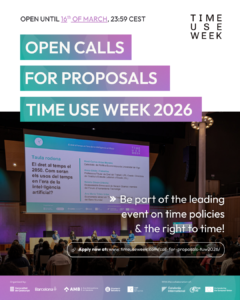
On October 13, 14, and 15, Barcelona hosted the 11th edition of Time Use Week (TUW2025), the leading international event on time policies, with more than 4,600 participants from 49 different countries.
Under the title “The Right to Time in the Age of Artificial Intelligence”, the event brought together more than 40 experts from around the world in fields such as artificial intelligence, work, care, democracy, and urban innovation to discuss and reflect on how technological advances can promote an organization of time that guarantees the Right to Time for everyone.
New this year, TUW2025 has been decentralized throughout Catalonia thanks to the collaboration of entities, companies, and institutions committed to the Right to Time, which have organized and implemented more than 85 side events on time (talks, exhibitions, film forums, workshops, etc.) and transformative actions (time management measures) that have improved the time organization of their environment.
7. Time policies, key tools for ensuring that everyone's right to time is upheld in the age of AI

The conversations, debates, and workshops held during Time Use Week 2025 concluded with a key message: governments and the social and productive fabric of society need to rethink and regulate the use of technology. Technological advances can free up time, but only if they are applied with social and ethical criteria; otherwise, they generate more haste and inequalities.
To guarantee the right to time in the age of AI, these eight key points must be taken into account:
- Reducing jet lag, which affects more than 80% of the working population in Spain, and time poverty must be one of the priorities in the age of AI.
- AI should not only seek efficiency, but also incorporate criteria and intentions aimed at promoting greater well-being, a better quality of life, and a more equitable use of time.
- AI must take on tasks that do not require human ingenuity, freeing up time for creative, personal, and socially meaningful activities.
- AI does not exponentially increase business productivity. When performing complex tasks, time is lost correcting errors and adding the “human touch”.
- Regulation and collective bargaining are key to ensuring healthy and equitable organization of working time.
- Digital acceleration challenges democratic rhythms, such as deliberation and consensus, which require slow times.
- We must praise slowness, go on a digital diet, and slow down the excessive acceleration that wears down society, preventing cell phones and apps from becoming “time thieves”.
- Time policies are essential tools for ensuring well-being and equality in the digital age. That is why the institutions present have committed to working to ensure that the right to time reaches everyone in the age of artificial intelligence.
8. More than 300 professionals from 36 countries have been trained in time policies during the Time Academy.

From June 30 to July 3, the Time Academy, the first international training course on time policies, was held, with more than 300 participants from 36 countries: professionals from local and regional government and other fields involved in the design and implementation of public policies.
The training addressed key aspects of incorporating the time perspective into institutional governance: identification, design, implementation, and evaluation of time policies.
As a result of the knowledge shared during the Time Academy, the “Time Policies Toolkit” was designed, as a practical guide for institutions to recognize, evaluate, and implement time policies that place time management at the center of public service and urban development.
9. The benefits of time policies for improving people's daily lives are highlighted

In 2025, it has been proven that time policies—related to care, work, mobility, and social and democratic participation—work and improve the lives of users.
A particularly moving moment during Time Use Week 2025 was the session “Time policies that improve lives” in which four users of the ‘Concilia’ (Barcelona) and “Little” (Santa Coloma de Gramenet) projects shared how these care and babysitting services make it easier for them to balance work and family life and offer them breathing space. Valentina Ríos, a user of “Little Ciba”, explained: “Little Ciba has given me something that seems simple, but that changes everything: time. Time to study, take care of myself, and breathe.”
The witnesses in the 30-minute report “The impossible schedules” broadcast in June, in which the TUI collaborated, are another example. Through personal stories, the work presents solutions to everyday challenges in time management: excessively long working and school days, difficulties in balancing work and family life, and lack of rest.
The report highlights, among other things, the experience of Mercabarna Fruit and Vegetable Market, which in the 1980s replaced the night shift with morning hours to ensure generational renewal and promote a more balanced lifestyle. As Pere Prats, a businessman in the sector, says: “My parents were always very tired and I rarely saw them at home. Two years after the change, they said they would never go back: that new life was non-negotiable”.
10. The reduction and rationalization of working time is progressing through debate and the creation of new tools for companies and administrations

In 2025, work to advance the approval of the reduction of the working week to 37.5 hours has continued. Political groups in the Congress of Deputies and the TUI have met to analyze the benefits of the measure and share strategies to facilitate its implementation in small and medium-sized enterprises, as well as in the service sector.
In addition, public debate has been encouraged in spaces such as the forum “The impact of the new working day. Advances and challenges” by Infolibre and the talk “It’s time for a reduction in working hours and work-life balance”, co-organized with the Surt Foundation.
At the same time, new tools have been created to promote the rationalization of working time at the local level. On the one hand, the fifth compilation of good practices in time policies has been produced, the Local & Regional Time Agenda 5 “Towards a more rational and sustainable working time”, which brings together working time policies from cities and regions that promote more conciliatory, healthy, efficient, and sustainable working models.
On the other hand, the Barcelona Metropolitan Area, in collaboration with the Time Use Initiative, has designed a guide that provides guidance to metropolitan municipalities on promoting measures to rationalize working time from the areas of economic promotion, encouraging more sustainable and balanced working models.
Finally, Sant Boi de Llobregat has launched the “Conciliacció” project, a public-private network that promotes the implementation of working time management measures in private companies to improve work-life balance and the well-being of workers and increase efficiency and talent retention. Within the framework of the project, the TUI has developed a tool to assess and compare the state of work-life balance by sector.
11. New data on time use in Europe

Between the end of 2025 and throughout 2026, some twenty European countries will publish the results of the new edition of the Harmonised European Time Use Surveys (HETUS) promoted by Eurostat. This tool is key to guiding time policies in Europe over the next decade.
The survey, which analyses how the population distributes its time among different daily activities, is particularly relevant because it highlights fundamental factors in the perpetuation of time poverty — such as the division between paid and unpaid work —, collects the habits and time needs of specific groups, such as young people and older people, which other surveys do not cover, and allows for the examination of stress and mental health levels related to daily time management.
It also provides solid evidence for the design of time policies and facilitates international comparison between European countries.
12. The debate on eliminating the biannual daylight saving time change in 2026 is back on the agenda of the European Commission and the European Council—the bodies responsible for its final approval.

In 2025, two key moments have reactivated the debate on the European agenda regarding the elimination of biannual clock change, a demand supported by 80% of Europeans and backed by scientific evidence on its negative effects on health, the economy, and the environment.
On March 18, a conference organized by MEP Seán Kelly and the TUI brought together experts and MEPs at the European Parliament to establish a roadmap to push for the approval of the end of biannual clock change in 2026. Petra Soderqvist, assistant to the Commissioner for Transport, confirmed the Commissioner’s interest in this issue.
In October, the Spanish government announced its support for the elimination of biannual clock change and brought the proposal to the EU Council, which has the final say. Dan Jorgensen, Commissioner for Energy, supports the initiative and is committed to reaching a consensus among member states.