

- The Time Use Initiative participated in the Marmara Urban Forum 2025 (MARUF 2025), which brings together the world’s leading urban actors every two years with the aim of exchanging good practices and devising collective solutions to address global challenges at the local level.
- With the round table discussion ‘Tick-Tock, Tick-Tock, Local Time Policies’, MARUF 2025 has placed the right to time on the international urban agenda and, especially, in Turkish cities, demonstrating how time policies are key tools for improving equality, sustainability, efficiency and the health of citizens.
- The round table presented several projects that promote the Right to Time in cities around the world, including cases such as those of Barcelona (on care time and education time), Milan (on sustainability), Bogotá (on care time), Rennes (on travel time and mobility time) and Bolzano and the Barcelona Metropolitan Area (which integrate data to plan time policies).
The Time Use Initiative participated in the Marmara Urban Forum ‘Cities Developing Solutions’, organised by the Union of Marmara Municipalities (UMM) and held from 1 to 3 October in Istanbul (Turkey).
The Forum is an international meeting place for stakeholders (public institutions, international organisations, local governments, NGOs, universities, companies and social entities) that promotes the exchange of innovative and effective practices that offer long-term solutions to global challenges at the local level: disaster management, the climate crisis, mobility, governance, sustainable development, housing, artificial intelligence and, this year, time management, among others.
Tick-Tock, Tick-Tock, Local Time Policies
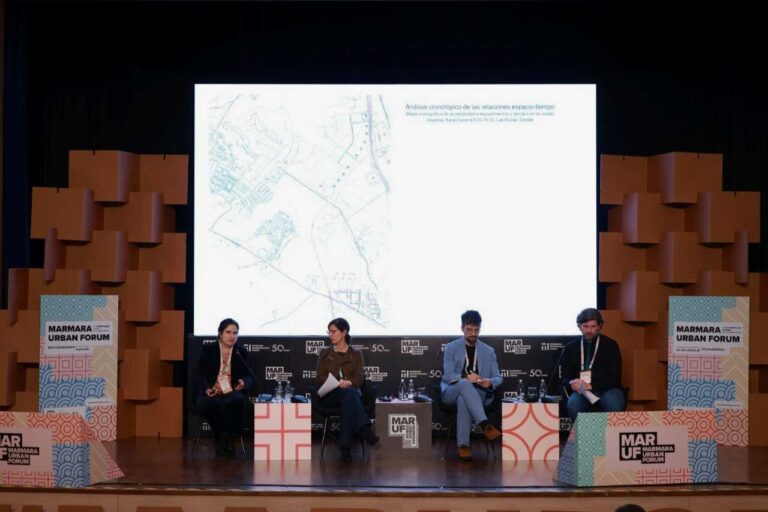
MARUF 2025 held a round table discussion entitled ‘Tick-Tock, Tick-Tock, Local Time Policies’, which placed the right to time and time management policies on the agenda of cities as key tools for improving equality, sustainability, efficiency and the well-being of citizens.
The round table was attended by representatives of the Local and Regional Time Network: Marc Martorell, public policy expert at the Time Use Initiative, the organisation that holds the Network Secretariat; Björn Gernig, member of the German Association for Time Policies and representative of the Network’s Executive Board; Laura de Caralt, head of time management policies at the Barcelona City Council’s Feminism and LGTBI Services Department and representative of the Network’s Executive Board; and Inés Sánchez de Madariaga, professor in the Department of Urban Planning at the Higher Technical School of Architecture (ETSAM) and the Polytechnic University of Madrid.
During the session, which followed on from a previous meeting on the right to time, policies and experiences were presented that promote a fairer and more efficient use of time, with the aim of building healthier cities that are more respectful of citizens’ time.
Good practices shared in time policies
Barcelona highlighted several initiatives in the area of time, such as the Time Agreement and the NUST Network (Network of Companies for a New Working Time), which promote more equitable, healthy and efficient time management both at work and in citizens’ lives, as well as the Concilia project, the Carer’s Card, Protecting Schools and the Advisory Service for Companies on Equality and Organising Time.
Other international examples included the mobility time policy in Rennes (France), which has reduced public transport congestion by 17% by coordinating school and work schedules; the Care Blocks in Bogotá (Colombia), a care time policy based on reorganising basic services in districts, focusing on the needs and the uses of time of carers and their families; and Milan’s Air and Climate Plan (Italy), which incorporates the management of daily time use into its strategy to reduce pollution, decentralise services and promote flexible schedules with actions such as offering decentralised local services or promoting multi-functional infrastructure.
Finally, the value of tools such as surveys and time use indicators was highlighted for designing public policies based on evidence of citizens’ needs, as well as the role of the Time Chief Officer, responsible for coordinating and evaluating municipal time policies, with examples such as Bolzano and the Barcelona Metropolitan Area.