This webinar will focus on the European Time Network, presenting its background, challenges and links with Tempo Territorial. It will also showcase time-related initiatives developed in different European countries, as well as current and upcoming projects and 2026 updates of interest to local and regional authorities.

An online presentation of SPATIOTEMPO, a project within the 15-Minute City Transition Pathway (15mC TP) of the Driving Urban Transitions (DUT) programme. Developed through a collaboration between cities and universities in Bolzano, Barcelona, and Vienna, the project explores how time planning can contribute to more accessible, inclusive, and liveable 15-minute cities. The event will introduce the project’s aims, timeline, research methods, data collection tools, and participatory approaches, while providing an opportunity for exchange between researchers and policy makers.
A free, self-guided online activity by Right to Timelessness exploring when we want to see—or hide—the clock on our screens. Participants try an interactive demo, reflect on their preferences, and discover which options their devices currently offer. No registration or live attendance required.
Digitalisation has made it possible for many of us to work almost anywhere and at any time. By eliminating the daily commute and providing greater flexibility over when and where work is performed, working-from-home could give workers more control over their time and create opportunities to slow down. But does it really? Or does this flexibility simply allow us to fit more work, care and other activities into already busy lives, further accelerating the pace of everyday life? This interactive session starts from new evidence collected within the Horizon Europe project WinWin4WorkLife. Detailed time-use diaries allow us to compare how hybrid workers organise and experience their daily lives when working-from-home and when travelling to their usual workplace. We explore how working-from-home reshapes paid work, care, leisure, mobility and rest throughout the day; how workers experience these different uses of time; and for whom working-from-home contributes (or fails to contribute) to greater time autonomy, well-being and work-life balance. Building on these findings, a fishbowl discussion will bring together perspectives from policy, employers, employees, gender and civil society. Moving beyond the question of whether working-from-home is simply “good” or “bad”, we will ask when flexibility genuinely allows people to slow down, what organisational, household, spatial and institutional conditions are needed to make this possible, and who is responsible for creating them. We will also consider potential rebound effects: could the time gained through working-from-home ultimately lead us to do more rather than live better? Ultimately, the session asks how working-from-home can contribute to a genuine right to time in an accelerating society, and what employers, policymakers and society need to do to make that happen.

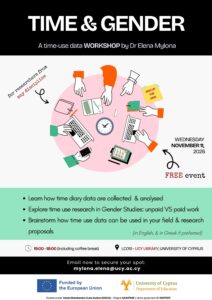
A 3-hour workshop where participants can learn how time diary data are collected & analysed, explore time use research in Gender Studies: unpaid VS paid work and brainstorm how time use data can be used in their field & research proposals.